The Weight of the Set: Musicians Are Finally Talking About Mental Health—and It's About Time
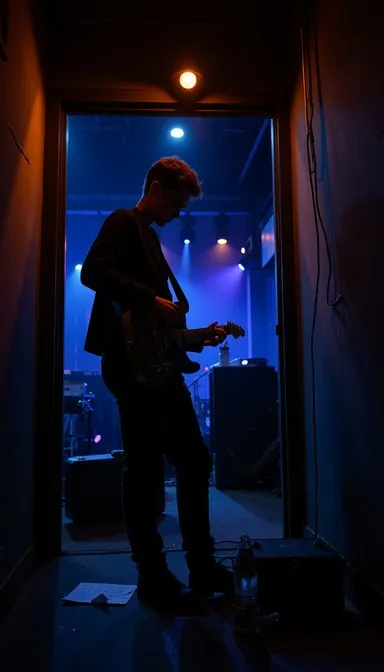
Photo: musician backstage alone contemplative quiet moment, via images.stockcake.com
There's this image that gets romanticized constantly in music culture—the brooding artist, hollowed out by feeling too much, creating beauty from pain. It looks great on an album cover. It makes for compelling press. And it has quietly convinced generations of musicians that struggling is part of the deal. That if you're not suffering, you're not really making something.
That narrative is exhausting. And increasingly, indie musicians are saying so out loud.
The Myth We Need to Retire
Let's just say it plainly: the tortured artist trope has caused real harm. It's normalized untreated mental illness as a creative prerequisite. It's made musicians feel like seeking help is somehow a betrayal of their art. It's built a culture where admitting you're struggling feels like weakness, and where pushing through at any cost is treated as a badge of honor.
The truth is a lot less cinematic. Anxiety doesn't make you write better songs—it makes you second-guess every lyric until 4 a.m. and then sleep through your soundcheck. Depression doesn't add depth to your music—it makes you want to cancel the show entirely and stare at the ceiling of a Hampton Inn outside of Columbus, Ohio.
Suffering isn't the source of great art. Processing suffering is. And you can't process anything if you're drowning in it untreated.
What Actually Happens Before the Show
Pre-show anxiety is almost universal among performers, but the conversation usually stops at "butterflies." For a lot of musicians, it goes way past that.
One indie singer-songwriter described it this way: "About an hour before we go on, I start catastrophizing. Not just about the show—about everything. Did I ruin a friendship last week? Is the band falling apart? Is this whole thing pointless? And then I walk out there and it's fine, and then the next night it happens again."
That cycle—dread, performance, relief, repeat—is exhausting in a way that's hard to explain to people who haven't lived it. And when you're doing it four or five nights a week on a DIY tour, sleeping in a van, eating gas station food, and managing your own booking and social media on top of it, the cumulative weight becomes genuinely dangerous.
Several musicians who've spoken publicly about their mental health in recent years have described the touring lifestyle as uniquely isolating—not because you're alone, but because you're surrounded by people and still completely untethered from your normal support systems. Your therapist is back home. Your close friends are in a different time zone. The person sitting next to you in the van is also struggling and also pretending not to be.
The DIY Tax on Mental Health
Major label artists have teams. Publicists, managers, tour managers, road crews. Someone handles the logistics so the artist can focus on the performance. That infrastructure isn't just convenient—it's a genuine buffer against the kind of decision fatigue and administrative overwhelm that grinds people down.
Independent musicians don't have that buffer. They are the publicist, the booking agent, the merch manager, the social media coordinator, and the artist—all at once, all the time. The creative work that presumably started this whole thing gets squeezed into the margins of an endless administrative grind.
Burnout in that context isn't a personality flaw. It's a structural inevitability if you don't actively build in protection against it.
What does that protection look like? A few musicians who've been candid about navigating burnout have pointed to some common threads: setting hard limits on how many consecutive tour dates they'll book, building in mandatory days off that aren't optional no matter how good the offer looks, and treating rest as a non-negotiable part of the job rather than a reward for finishing work that never actually ends.
Therapy, Medication, and the Stigma That's Finally Fading
The shift in how openly musicians talk about therapy and medication is genuinely significant. Five or ten years ago, admitting you were in therapy felt like an overshare in most band contexts. Now it's increasingly common—and increasingly normalized—to hear artists talk about it in interviews, in social media posts, in lyrics.
That normalization matters. It gives younger musicians permission to seek help without feeling like they're somehow opting out of the artist experience. It challenges the idea that clarity and stability are the enemies of creativity. And it reframes the whole conversation: mental health care isn't about making yourself feel less. It's about making yourself functional enough to actually use what you feel.
Medication is still a more fraught conversation in music circles, partly because of outdated fears about what it might do to the creative process. Musicians who've been open about using antidepressants or anti-anxiety medication often push back hard on this concern. The consensus from those voices tends to be consistent: untreated mental illness doesn't protect your creativity. It eats it.
Vulnerability Onstage vs. Vulnerability Offstage
Here's a distinction worth sitting with: there's a difference between performing vulnerability and actually being vulnerable.
A lot of musicians are extraordinarily good at the first one. They can pour their guts out in a song, make a room full of strangers feel genuinely seen, and then walk offstage and tell their bandmates they're fine when they're clearly not. The performance of emotional openness can actually become a substitute for the real thing—a way of releasing pressure without ever addressing what's underneath it.
Real vulnerability—the kind that happens in a therapist's office or in a hard conversation with someone you trust—is less controlled, less cathartic in the moment, and a lot more uncomfortable. It's also the kind that actually changes things.
Being honest about this gap isn't about criticizing artists for how they perform. It's about recognizing that the stage can't do all the work. The crowd's energy is real and it matters, but it's not a substitute for support systems that exist when the show is over and the lights are back up.
Starting the Conversation in Your Own Band
If you're in a band and nobody's ever explicitly talked about mental health—how everyone's actually doing, not just how the tour's going—that's worth changing. It doesn't have to be a formal sit-down. It can be as simple as making space for honesty when someone seems off, or agreeing as a group that it's okay to say when something's too much.
Bands are small, intense communities. The relationships inside them carry enormous weight. When they function well, they're a genuine source of support. When they don't, they can amplify every individual struggle until something breaks.
The musicians speaking most honestly about mental health right now aren't doing it because it's trendy. They're doing it because they wish someone had said it to them earlier—before the panic attacks became routine, before the burnout hollowed them out, before they had to learn everything the hard way.
The music is worth making. So are the people making it.